In Texas, DUI and DWI are two different charges. Driving under the influence applies only to drivers under 21, while driving while intoxicated applies to adults. Which charge you face changes the penalties, the court, and the defense.
Our Kaufman DUI lawyer team at Garcia, Garcia & Mullen Criminal Defense & Injury Lawyers defends both, from the traffic stop through every setting at the Kaufman County Justice Center. We maintain an appointment-only criminal defense office at 307 N Washington Street in Kaufman, so your case is handled by attorneys who work in these courts and know how this county moves its dockets. If you or your child was arrested in Kaufman, call (214) 214-1000 for a free case evaluation.
We defend intoxication charges, and that focus shapes what we do first. Our team requests the dashcam and body camera footage, the officer's probable cause affidavit, the field sobriety test documentation, and the breath or blood testing records before anyone discusses a plea.
Our criminal defense practice is led by an attorney who has defended clients against state and federal charges throughout his career and is a second-generation criminal defense attorney. That background matters in a county where the felony docket now spreads across three district courts.
We also treat the license case and the criminal case as two separate matters because Texas law does. Kaufman is one of the communities we serve across North Texas, and we take cases in both the county courts at law and the district courts here.
When the driver is under 21, a parent is usually the one making the call. We explain the charge, the license consequences, and the court schedule to the family, then keep everyone informed as settings are made and reset. Young drivers and their parents get straight answers about what a conviction would follow them into.
Most states use DUI and DWI interchangeably. Texas does not. The two terms point to separate statutes, separate age groups, and separate standards of proof.
Getting that distinction right early affects everything that follows, including which court hears the case and what a conviction leaves behind on a record.
Under Texas Alcoholic Beverage Code § 106.041, a minor commits an offense by operating a motor vehicle in a public place while having any detectable amount of alcohol in the minor's system. There is no 0.08 threshold. A single drink can support the charge.
The same statute says a DUI under § 106.041 is not a lesser included offense of DWI. Prosecutors can pursue either charge when the facts support it. We defend underage DUI charges for drivers under 21 and for the parents standing behind them.
For drivers 21 and older, Texas Penal Code § 49.04 makes it an offense to be intoxicated while operating a motor vehicle in a public place. Under § 49.01, intoxicated means either an alcohol concentration of 0.08 or more, or the loss of normal mental or physical faculties.
That second definition carries real weight. The State can pursue a DWI charge with no test results at all, relying solely on an officer's observations. Our adult DWI defense work starts with what that evidence actually shows.
Consequences depend on the driver's age, prior convictions, and the results of any testing. A first charge and a third charge belong in different courts and carry different exposure.
A DUI under § 106.041 is a Class C misdemeanor in most cases. The statute raises the offense level only when a minor who is not a child has been previously convicted at least twice under the section. That version is punishable by a fine of $500 to $2,000, confinement in jail for a term not to exceed 180 days, or both.
Courts must also order community service. The range runs from 20 to 40 hours for a minor with no prior conviction under the section, and from 40 to 60 hours for a minor who has one.
Section 106.115 requires the court to order an alcohol awareness program or a substance misuse education program and authorizes the court to suspend or deny a license. For a student, that combination affects school, work, and college plans.
A first DWI is generally a Class B misdemeanor, and § 49.04 writes a minimum term of confinement of 72 hours into the statute itself. If an analysis of a specimen showed an alcohol concentration of 0.15 or more at the time the analysis was performed, the offense is a Class A misdemeanor.
Section 49.09 governs prior convictions. One qualifying prior makes the offense a Class A misdemeanor with a minimum term of confinement of 30 days; two priors make it a felony of the third degree.
One change took effect on September 1, 2025. Under a subsection added to § 49.04 by Senate Bill 826, a DWI committed while operating a motor vehicle in a school crossing zone during the reduced speed limit period is a state jail felony.
The license case runs on its own track and its own clock. It is an administrative proceeding rather than part of the criminal case, and it moves faster than the courtroom side.
Under Texas Transportation Code § 724.041, a written request for a hearing must reach the Department of Public Safety no later than the 15th day after notice of suspension. Those are calendar days. A timely request also stays the suspension until an administrative law judge issues a final decision.
Missing that window forfeits the hearing.
Section 724.035 sets the consequences of refusal. Refusing to provide a specimen results in an 180-day suspension. That period rises to two years when the driving record shows an alcohol-related or drug-related enforcement contact during the preceding 10 years.
The hearing itself is narrow. An administrative law judge decides a limited set of licensing questions rather than guilt or innocence, and the outcome does not resolve the criminal charge either way.
Filing the hearing request is one of our first steps in every intoxication case. The hearing also puts the arresting officer's account on the record under oath, which can matter later in the criminal case. Even when the suspension stands, what the officer says at that hearing becomes material we can work with.
Kaufman County runs its criminal dockets from the Justice Center at 1902 E. US Highway 175 in Kaufman. Knowing where a case will land helps you plan around work, school, and childcare.
Class A and Class B misdemeanors, a category that covers most DWI charges, are filed in County Court at Law and County Court at Law 2. Felony charges are heard in the 86th, 422nd, or 489th District Court, with the 489th being the newest of the three. Class C offenses, including a standard underage DUI, move through the justice of the peace and municipal courts.
Kaufman County has grown quickly, and its court structure expanded to keep pace. Settings, plea dockets, and the pace of a case differ from Dallas County, which is why representation with local footing matters here.
An arrest anywhere in the county generally routes to the same complex, whether it happened on US Highway 175, in a city with its own police department, or during a stop by the sheriff's office. That means the first court date is rarely close to home for everyone involved.
Yes. Section 106.041 states that a DUI is not a lesser included offense of DWI, so prosecutors can file either charge when the evidence supports it.
Refusal brings a 180-day license suspension under § 724.035, or a two-year period when a qualifying enforcement contact appears in the previous 10 years. It also leaves the State without a specimen analysis.
Usually, the case stays in the county where the arrest happened unless venue changes. For many settings, we can appear on your behalf.
It is a criminal charge. A Class C misdemeanor is fine-only, but a conviction still creates a record that follows a young driver.
Within a few days. The 15-day license hearing deadline runs from the date of notice, and body camera video and testing records are easier to preserve early.
It depends on the charge, the driver's age, and how the case resolves. Texas treats an underage DUI and an adult DWI under different provisions, so eligibility for relief is not the same in both situations. We review what applies once we have the file.
A DUI or DWI arrest in Kaufman opens two cases at once, and one of them carries a 15-day deadline. Our Kaufman DUI lawyer team at Garcia, Garcia & Mullen handles both, from the license hearing through the final court setting.
Our criminal defense office at 307 N Washington Street, Suite 110B, in Kaufman is available by appointment, and criminal defense attorney Lukas Garcia leads that practice. We review the stop, testing, and reports, then explain the options realistically available in your situation.
Call (214) 214-1000 or use our contact form to schedule a free case evaluation.


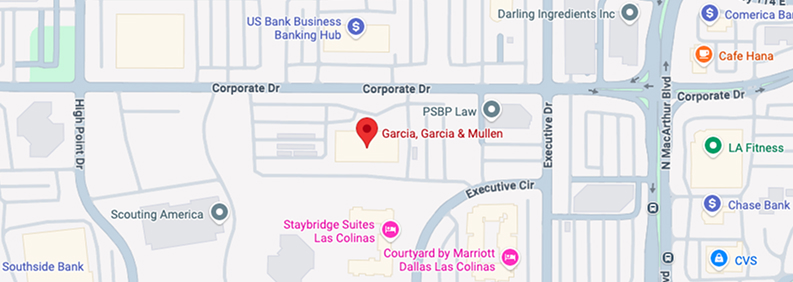 View Map/Directions



Phone: (214) 214 1000
Phone: (214) 214 1000