A criminal charge in Kaufman County puts your freedom, your job, and your record at risk from the day of arrest. Garcia, Garcia & Mullen Criminal Defense & Injury Lawyers defends people charged with misdemeanors and felonies across Kaufman County, and you can meet with us at our office on North Washington Street in the county seat. Our practice covers DWI, drug charges, assault and family violence, sex offenses, theft, and federal cases.
The State begins building its file immediately, and the choices made in the first few days often shape the rest of the case. A Kaufman criminal defense lawyer can step in before those choices harden. Call (214) 214-1000 to schedule a free case evaluation.
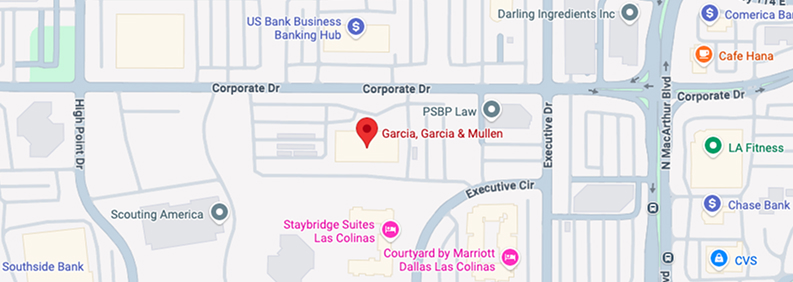
Our firm keeps an office in Kaufman at 307 N Washington St, Suite 110B, available by appointment. Cases from this county are filed, argued, and resolved here, and counsel who appears locally removes a layer of distance from your defense.
Criminal defense is the whole of Lukas Garcia’s legal career, not one service line among many. He is a second-generation state and federal criminal defense attorney and earned his law degree magna cum laude from UNT Dallas College of Law. That focus shapes how we read a police report, a lab result, or a search warrant affidavit.
Our practice also reaches beyond state court. Lukas is licensed in Texas and admitted in all four federal districts of the state: the Northern, Southern, Eastern, and Western Districts.
Membership keeps us current on defense practice. Our attorneys are members of the Texas Criminal Defense Lawyers Association, the Dallas Criminal Defense Lawyers Association, and the National Association of Criminal Defense Lawyers. Lukas, our founding defense partner mentioned earlier, is also an inaugural member of the North Texas Federal Criminal Law American Inn of Court.
Preparation drives everything else. Before any discussion of resolution, we examine the stop, the search, the questioning, and the chain of custody behind the State's evidence. A defect in any of those steps can change the defenses available to you.
Aggressive defense is not the same as loud defense. It means filing the motion that tests the search, subpoenaing the record the State did not hand over, and being ready to try the case when an offer does not match the evidence.
You will also know where your case stands. Court settings, what the State has produced, and what each option actually means are things you should hear from your lawyer, not discover at the courthouse.
Our criminal defense practice covers the charges that fill the Kaufman County docket, from first-offense misdemeanors through serious felony allegations. Each area below involves different evidence, different penalty exposure, and a different approach. What they share is that the State's case is built from records, and records can be tested.
Every DWI case turns on the stop, the field sobriety testing, and the breath or blood analysis. We request the in-car video, the maintenance records, and the analyst's file, then test whether the State can actually prove intoxication. Our DWI defense practice covers first offenses through felony repeat charges.
Texas grades controlled substance offenses by substance and quantity, so a small difference in weight can move a case from misdemeanor to felony territory. In drug charges, we examine the basis for the search, the handling of the evidence, and the lab analysis behind the alleged weight.
A family violence finding follows a person long after any sentence ends, reaching firearm rights, housing applications, and custody disputes. We defend assault and family violence cases by examining the 911 call, the injuries documented at the scene, and the relationships behind every statement given.
Sex offense allegations often surface during an investigation, before any arrest, which is when an early defense presence matters most. Our attorneys review forensic interviews, digital evidence, and the sequence of events surrounding the outcry, and we advise clients on contact with investigators while a case is still being assembled.
Federal cases follow separate rules, separate sentencing structures, and separate timelines. Because our founding defense partner holds admission across all four Texas federal districts, we defend federal criminal charges arising from a Kaufman County investigation without transferring your file elsewhere.
Theft grading depends on the value assigned to the property, and that number is frequently disputed. We challenge valuation, ownership, and intent in theft and property cases, and we address the collateral damage a theft conviction does to employment in fields that require a clean record.
Most criminal cases in this county run through the Kaufman County Justice Center at 1902 E US Highway 175. The county's trial courts include the 86th, 422nd, and 489th District Courts, as well as County Court at Law and County Court at Law 2. Four justice of the peace precincts also serve the county.
Where your case lands depends on how it is charged. The Kaufman County District Attorney's Office is organized with a felony division tied to the 86th and 422nd District Courts and a misdemeanor division tied to the County Court at Law. Class C misdemeanors, which carry a fine and no jail exposure, are handled in justice and municipal courts instead.
The first court event comes quickly. Under Texas Code of Criminal Procedure Article 15.17, a person who has been arrested must be taken before a magistrate without unnecessary delay and no later than 48 hours after the arrest. At that appearance, the magistrate states the accusation, gives the required warnings, addresses the right to counsel, and sets conditions of release.
Everything after that runs on the court's calendar. Felony cases proceed toward indictment and a series of district court settings, while misdemeanor cases are set for appearances in the county court at law. Between those dates, the substantive work happens: We review what the State has produced, file motions, and negotiate from a documented position.
Court dates are not optional, and a missed setting creates a second problem on top of the original charge. Where a court permits counsel to handle a routine setting without the client present, that option is worth raising early. A case can run for months, and few people can absorb repeated weekday absences from work.
We represent clients throughout the county, including Terrell, Forney, Crandall, Kemp, Mabank, and the other communities we serve across Kaufman County.
Texas Penal Code Chapter 12 sorts offenses into three misdemeanor classes and five felony categories. The classification assigned to your charge sets the entire penalty range before a single fact is argued.
Misdemeanors carry these ranges:
Felony exposure climbs sharply from there:
Prior convictions change the arithmetic. A prior felony conviction can elevate a third-degree felony to the second-degree range and a second-degree felony to the first-degree range. Two prior sequential felony convictions can raise the minimum term to 25 years.
Repeat misdemeanor convictions work in the same direction, raising the minimum jail term available on a later charge. Because enhancements must be pleaded and proved like any other element, the prior convictions themselves warrant close examination.
Movement runs the other way as well. A court may sentence a person convicted of a state jail felony within the confinement range for a Class A misdemeanor when it finds that result best serves the ends of justice. A prosecutor may also be authorized to pursue a state jail felony as a Class A misdemeanor.
A sentence is also only part of the exposure. A conviction can affect professional licenses, immigration status, firearm rights, and eligibility for housing, and those effects routinely outlast any jail term or fine. We weigh collateral consequences from the start, because a resolution that looks acceptable on the penalty range alone can still be the wrong one for your circumstances.
None of this is fixed at the moment of arrest. Classification rests on facts the State carries the burden to prove, and those facts remain open to challenge until a case resolves.
The hours after an arrest carry more weight than most people expect. The steps below protect your position while the case is still forming.
Bond conditions deserve the same attention. Conditions set at the magistrate appearance can restrict where you go, who you contact, and whether you keep driving. Those terms can often be revisited once a lawyer is involved.
Family members frequently want to help by explaining the situation to investigators. That instinct is understandable, and it regularly damages cases. Route those conversations through counsel instead.
Social media deserves a mention of its own. Posts, comments, and photographs are routinely pulled into criminal files, and deleting them after the fact can create a separate allegation. Leave the accounts alone and tell your lawyer what is on them.
Felony cases go to the county's district courts, and the District Attorney's Office runs its felony division through the 86th and 422nd District Courts. Misdemeanors above Class C are handled in the County Court at Law, while Class C misdemeanors go to justice and municipal courts. Most of this activity takes place at the Kaufman County Justice Center on East US Highway 175.
Texas law requires that you appear without unnecessary delay and no later than 48 hours after the arrest. The magistrate states the accusation, gives the statutory warnings, addresses your right to counsel, and sets conditions of release.
A state jail felony carries a sentence of 180 days to 2 years in a state jail facility. A third-degree felony carries a sentence of 2 to 10 years in prison. Both allow a fine of up to $10,000.
A Class A or Class B misdemeanor carries jail exposure and leaves a record that surfaces in background checks for years. Employers, landlords, and licensing boards all see it.
Yes. Texas enhancement provisions can move a third-degree felony into the second-degree range and a second-degree felony into the first-degree range when a prior felony conviction is proved. Two prior sequential felony convictions can substantially increase the minimum term.
Yes. Lukas Garcia, our founding defense partner, is admitted in the Northern, Southern, Eastern, and Western Districts of Texas, which covers federal practice statewide. A case that begins with a local arrest and later moves into federal court stays with our team rather than being referred out.
Charges do not improve while you wait for them to resolve on their own. Garcia, Garcia & Mullen represents people facing misdemeanor and felony charges throughout Kaufman County. A Kaufman criminal defense lawyer from our firm can review the paperwork, explain the classification you are facing, and lay out the options realistically in front of you.
Call (214) 214-1000 to schedule a free case evaluation. Bring whatever you have, including the charging paperwork, your bond conditions, and anything you were handed at the jail. The sooner we see the file, the more room there is to work with it.


 View Map/Directions



Phone: (214) 214 1000
Phone: (214) 214 1000