If your child was arrested for an underage DUI in Irving, you need answers fast, and Garcia Garcia & Mullen Criminal Defense & Injury Lawyers is ready to help. A single mistake should not decide your child's future. Our Irving underage DUI lawyers defend minors under 21 charged under the Texas zero-tolerance law, and we build a defense strategy designed to protect your child's record, license, and opportunities ahead. The choices you make in the first days matter. Call (214) 214-1000 to speak with our team about your child's charge and what happens next.
Worried about the clock already running? A short call can tell you which deadlines apply to your child's case.
An underage DUI charge lands on a young person who has never dealt with the courts, and it lands on parents who feel powerless. Our team steps into that gap.
We defend minors accused of alcohol-related driving offenses across Irving and the surrounding North Texas courts. Our attorneys handle criminal cases in Dallas, Tarrant, Collin, and Denton counties, so we know how local prosecutors and judges approach charges involving young drivers.
We treat these cases as what they are: a fight to keep one mistake from becoming a permanent mark. That means examining the traffic stop, the testing, and the arrest before anyone assumes the charge will stick.
Parents also get straight answers from us. You will know what your child is facing, what options exist, and what each path could mean for school, work, and driving privileges. From the free case evaluation forward, our team keeps you informed at every step.
We also understand what is uniquely at stake for a young client. A minor's case is not only about the current charge; it is about protecting the record that colleges, employers, and licensing boards will one day review. Our defense strategy weighs the immediate penalties against those long-term effects, so decisions made today do not create problems years from now.
Texas treats underage drivers differently from adults, and the exact charge changes everything about the penalties. Understanding the difference is the starting point for any defense.
An underage DUI falls under the Texas Alcoholic Beverage Code Section 106.041, the state's zero-tolerance law. A minor commits this offense by operating a motor vehicle in a public place with any detectable amount of alcohol in their system. There is no legal blood alcohol threshold. Even a trace amount can support the charge.
A DUI under this statute is a Class C misdemeanor for a first offense. It carries a fine of up to $500 and no jail time for a first offense, but it still threatens your child's license and record.
A DWI is a separate and more serious charge. Under Texas Penal Code Section 49.04, a driver of any age can face DWI charges with a blood alcohol concentration (BAC) of 0.08 or higher, or when alcohol or drugs impair normal physical or mental faculties. A minor charged with DWI faces the same offense as an adult would, including the possibility of jail time.
The DUI charge under Section 106.041 is not a lesser included offense of DWI. It is a distinct charge under a different part of Texas law, prosecuted separately, with its own penalties. That distinction affects how the case is defended and what outcomes are possible.
Age also shapes how the case is handled. A driver who is 17 or older is treated as an adult in the criminal courts for these charges, while a younger driver's case may proceed through the juvenile system. Knowing which track your child's case follows is essential to protecting them.
Because the line between these charges often comes down to test results and the officer's observations, the details of the stop deserve close review. Our attorneys look at exactly how each charge was built.
The fine is rarely what worries parents most. The lasting consequences reach the driver's license, the criminal record, and everyday freedom.
A first underage DUI conviction under Section 106.041 generally carries the following:
Penalties climb with each additional offense. A second conviction can bring a longer suspension and more community service, and a third offense for a minor who is not a child can be charged as a Class B misdemeanor, carrying a fine of $500 to $2,000 and up to 180 days in jail.
License consequences can also start before any conviction. Under the Texas implied consent law, a minor who refuses a breath or blood test faces a driver's license suspension of 180 days for a first refusal, handled through the Administrative License Revocation process. That suspension is separate from the criminal case.
The Texas Department of Public Safety sets out the suspension periods that apply to underage alcohol offenses. Losing the ability to drive to school or work reshapes a family's daily life, which is why acting quickly matters.
Facing a suspension deadline? Call (214) 214-1000 and our team can walk you through the steps that protect your child's driving privileges.
A young person's record is supposed to open doors, not close them. A conviction can do lasting damage well past the courtroom.
College applications and scholarship reviews often ask about criminal history. An alcohol-related driving offense can complicate admissions and financial aid decisions during the years that shape a career.
Employers and professional licensing boards run background checks. A conviction on your child's record can surface for jobs, internships, and future licenses long after the case ends.
Car insurance costs can also rise sharply after an alcohol-related offense, and some insurers may decline coverage for a young driver entirely. These effects reach the whole household, not just the driver.
A conviction can also carry weight the next time your child interacts with the legal system. Under Texas law, a prior DUI can be used to enhance the penalties for a later alcohol-related driving charge, which raises the stakes on resolving the first case well.
Texas law does offer paths to limit this damage. Depending on the outcome, a minor may later qualify to have certain records expunged or sealed through nondisclosure, which is one reason the resolution of the case matters as much as the charge itself. We keep these long-term remedies in view from the start.
An arrest is an accusation, not a conviction. Our team looks for every opening the facts and the law provide.
We start with the stop. Officers need a lawful reason to pull a vehicle over, and evidence gathered after an improper stop can be challenged. Where the traffic stop lacked a valid basis, we move to suppress what followed.
We examine the testing. Breath and blood testing depend on proper procedure, calibration, and handling. When those standards break down, the reliability of the result comes into question.
We also pursue outcomes that protect the record. For a first Class C DUI, deferred disposition may be available, which can lead to dismissal when the minor completes court conditions such as an alcohol awareness program. For minors under 18, a parent may be required to attend that program as well. Where a suspension is at stake, we request an ALR hearing within the 15-day deadline to contest the administrative suspension while the criminal case proceeds.
Timing shapes the defense. Evidence like dashcam footage, calibration records, and officer notes can fade or be overwritten, and the short window to contest a license suspension does not pause while a family decides what to do. Involving our team early gives us more room to act.
Every case is different, and no lawyer can promise a specific result. What we can promise is a defense built on the actual evidence, aimed at protecting your child's future.
A first underage DUI under Section 106.041 is a Class C misdemeanor, which does not carry jail time. The main consequences involve fines, community service, an alcohol awareness program, and a driver's license suspension.
A DUI applies to drivers under 21 with any detectable amount of alcohol, while a DWI applies when a driver has a BAC of 0.08 or higher, or is impaired.
A first underage DUI conviction generally results in a 60-day license suspension. Refusing a breath or blood test can trigger a separate 180-day suspension through the Administrative License Revocation process.
In some cases, yes. Completing deferred disposition can lead to dismissal, and Texas law allows certain minor alcohol offenses to be expunged or sealed through nondisclosure once eligibility requirements are met.
Speaking with a lawyer first is wise. A guilty plea creates a conviction with lasting effects on your child's license, record, and future opportunities.
Avoid discussing the details of the arrest with anyone but an attorney, and note the date of the arrest so no deadline is missed. The 15-day window to request an ALR hearing moves quickly.
Your child's future is worth protecting, and the right defense starts now. Garcia Garcia & Mullen Criminal Defense & Injury Lawyers defends minors charged with underage DUI throughout Irving and North Texas, and our team is ready to review the stop, the evidence, and every option available in your child's case. Do not let one night define what comes next. Call our Irving underage DUI lawyers at (214) 214-1000 for a free case evaluation, or reach out through our contact page to speak with attorney Lukas Garcia and our defense team.


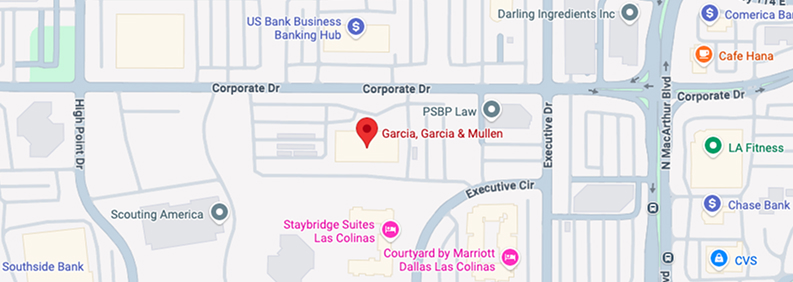 View Map/Directions



Phone: (214) 214 1000
Phone: (214) 214 1000