Getting arrested for a first-time DUI in Texas can upend your job, your license, and your record before you ever see a courtroom. The hours after an arrest are confusing, and the choices you make early often shape everything that follows. At Garcia Garcia & Mullen Criminal Defense & Injury Lawyers, we defend Texans across the Dallas–Fort Worth area who are facing a first alcohol-related driving charge and want to protect their future. If you need answers now, a free case evaluation is one phone call away.
Most people use DUI to mean any drunk driving arrest, but Texas law treats DUI and DWI as two separate offenses. Knowing which one applies to you changes the stakes entirely.
Driving while intoxicated (DWI) is the charge for adults and is governed by Texas Penal Code Section 49.04. It applies to anyone operating a motor vehicle in a public place while intoxicated by alcohol or drugs. Driving under the influence (DUI) is a separate, minor-only offense under Texas Alcoholic Beverage Code Section 106.041, and it applies to drivers under 21 with any detectable amount of alcohol.
That distinction matters because the penalties, the classification, and the defense strategy differ sharply between the two. When someone searches for a first DUI, they usually mean one of these two charges, so we cover both below. If you are unsure which one you are facing, our team can review your paperwork and tell you within minutes.
Texas defines intoxication two ways under Penal Code Section 49.01. The first is a blood alcohol concentration of 0.08 or higher. The second is the loss of normal use of your mental or physical faculties due to alcohol or drugs.
The second definition is where many drivers are surprised. You can be charged even with a BAC under 0.08 if an officer believes your faculties were impaired. A number on a breath test is not required for the state to file a case.
The law also requires that you were "operating" a motor vehicle in a public place. Prosecutors read operating broadly, and disputes over whether you were actually driving can become a real part of the defense. An open alcohol container in the vehicle raises the minimum jail term, even on a first charge.
A standard first-offense DWI is a Class B misdemeanor under Penal Code Section 49.04. That classification carries a real range of consequences that reach well past the courtroom.
For a first-offense Class B DWI, the penalties generally include the following:
If your BAC was 0.15 or higher at the time of testing, the charge becomes a Class A misdemeanor under Section 49.04(d), raising the fine ceiling to $4,000 and the maximum jail term to one year. A judge may also require an ignition interlock device on your vehicle for a high-BAC first offense. These are not minor traffic penalties, and a conviction stays on your record. If any of this describes your situation, our attorneys can walk you through your options in a free case evaluation.
A DWI arrest starts two separate cases at once. One is the criminal case in county court, and the other is an administrative license case with the Texas Department of Public Safety, called Administrative License Revocation (ALR).
The ALR case moves fast, and this is where many first offenders lose ground without realizing it. You have only 15 days from the arrest to request an ALR hearing in writing. Miss that deadline, and your license suspension takes effect automatically on the 40th day after arrest, with no hearing at all.
If you failed a chemical test, a first-offense suspension runs 90 days. If you refused testing, the suspension runs 180 days. According to the Texas Department of Public Safety ALR program, these suspensions apply even before any criminal conviction. Requesting the hearing also gives our team an early chance to question the arresting officer under oath, which can strengthen the criminal defense later.
Not every first DWI stays a misdemeanor. Certain facts can elevate a first offense to a felony charge, and the difference reshapes the entire case.
Under Penal Code Section 49.045, driving while intoxicated with a child passenger younger than 15 is a state jail felony, even on a first offense. A first DWI that causes serious bodily injury to another person can be charged as intoxication assault, and one that causes a death can be charged as intoxication manslaughter.
Consider a driver stopped for the first time with a child in the back seat. What would otherwise be a Class B misdemeanor is now a felony with far heavier exposure. Facing a felony DWI is a situation where experienced defense counsel is not optional, and we are ready to step in immediately.
For a driver under 21, Texas applies a zero-tolerance rule. Under Alcoholic Beverage Code Section 106.041, it is an offense for a minor to drive with any detectable amount of alcohol, not the 0.08 standard that applies to adults.
A first-offense DUI by a minor is a Class C misdemeanor, the same level as a traffic ticket. It carries a fine of up to $500, mandatory alcohol-awareness classes, 20 to 40 hours of community service, and a 60-day license suspension.
Even at this level, a conviction creates a record for a young person and can affect college and job prospects. The 15-day ALR deadline applies to minors too, so a parent facing this situation should act quickly rather than wait for the first court date.
A first DWI charge is not a conviction, and there are real points to challenge at every stage. Our approach starts with pulling apart the state's evidence piece by piece.
We examine several areas that commonly produce defense leverage:
When the stop, the arrest, or the testing does not hold up, that can support a motion to suppress evidence. Depending on the facts and the county, a first offense may resolve through dismissal, a reduced charge, or a pretrial diversion program for eligible first offenders. Every case is different, and we will evaluate yours honestly rather than promise a result we cannot control.
No, a standard first DWI is a Class B misdemeanor, or a Class A misdemeanor if your BAC was 0.15 or higher. It becomes a felony only with a child passenger, serious injury, or a death.
A first-offense Class B DWI carries a criminal fine of up to $2,000, plus a separate state fine on final conviction. If the charge is raised to a Class A misdemeanor, the fine ceiling rises to $4,000.
A first-offense Class B DWI carries a jail range of 72 hours to 180 days, but many first offenders receive probation instead of jail. The outcome depends on your facts, your record, and the county.
Yes, dismissal is possible when the stop, arrest, or testing is legally flawed, though it is never guaranteed. Some counties also offer pretrial diversion for eligible first offenders, which can lead to dismissal on completion.
If you failed a chemical test, a first-offense license suspension runs 90 days, and if you refused testing, it runs 180 days. You have only 15 days from arrest to request a hearing and contest it.
A DUI applies only to drivers under 21 and requires any detectable alcohol, making it a Class C misdemeanor. A DWI applies to intoxicated drivers of any age and is a more serious offense.
A first-offense DWI in Texas can mean jail exposure, a fine, a license suspension on a 15-day clock, and a permanent record, but a charge is not the end of the story. Our team defends first-time DWI and DUI clients throughout the Dallas–Fort Worth area, examining the stop, the testing, and every piece of the state's case for weaknesses.
We know how much your job, your license, and your reputation are riding on this outcome, and we handle each case with preparation and aggressive advocacy from the first call forward. You will always know where your case stands and what your options are.
Attorneys Lukas Garcia, Courtny Garcia, and Jim Mullen are ready to review your first DWI charge and build a defense strategy that fits the facts. Call Garcia Garcia & Mullen Criminal Defense & Injury Lawyers today at (214) 214-1000 for a free case evaluation.


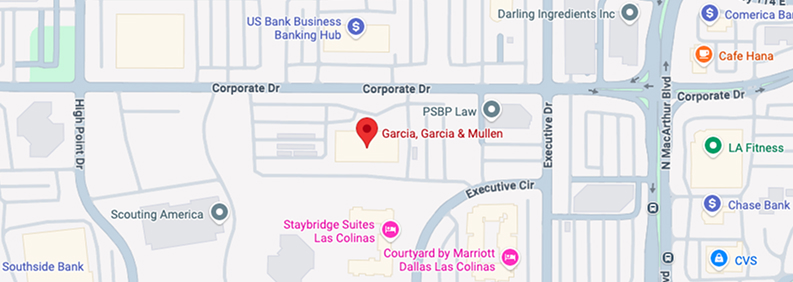 View Map/Directions



Phone: (214) 214 1000
Phone: (214) 214 1000