A Grand Prairie criminal defense lawyer at Garcia, Garcia & Mullen Criminal Defense & Injury Lawyers can step in now to protect your rights, your record, and your freedom. An arrest can move fast, and what happens in the first few days often shapes every option that follows. We answer the phone 24/7, review the facts behind the charge, and start building your defense before the prosecution gains ground.
Whether you face a driving while intoxicated (DWI) arrest, drug charges, an assault allegation, or a federal investigation, our team challenges the government's evidence at every stage. We examine the stop, the search, any statements, and the lab work before we advise you on a path forward. Call (214) 214-1000 today to schedule a free case evaluation with our criminal defense team.
When the state brings charges, you need a lawyer who has spent an entire career on the defense side. Lukas Garcia, our founding criminal defense attorney, has practiced criminal defense for his entire legal career. He is also a second-generation state and federal criminal defense attorney.
That background matters because some charges do not stay in state court. Federal cases follow their own procedures and move through a separate court system. He is admitted to practice in the Northern, Southern, Eastern, and Western Districts of Texas, so we can defend you if federal prosecutors bring charges.
His memberships include the Texas Criminal Defense Lawyers Association, the Dallas Criminal Defense Lawyers Association, the National Association of Criminal Defense Lawyers, and the Federal Bar Association. He was also an inaugural member of the North Texas Federal Criminal Law American Inn of Court.
Our criminal defense office is in Irving, and we represent clients throughout the communities we serve across North Texas, including Grand Prairie. You can reach our team 24/7, because an arrest does not wait for business hours.
From the first call, we treat your case as a fight worth taking seriously. Our attorneys look for weaknesses in the state's case, push back on unfair bond conditions, and keep you informed about every decision. When the evidence does not support the charge, we say so in negotiations and, when necessary, in court.
We defend misdemeanor and felony charges throughout Grand Prairie, from a first arrest to a federal investigation. Each type of case calls for its own defense strategy.
A DWI or driving under the influence (DUI) arrest can put your license, job, and record at risk at once. We review the reason for the stop, the field sobriety tests, and any breath or blood results. An unlawful stop or flawed testing can open defense options.
Drug cases often turn on how police found the substance and who actually possessed it. We challenge vehicle and home searches, question lab results, and look closely at whether the state can connect you to the drugs. Possession, distribution, and paraphernalia charges all deserve a full review.
Assault and family violence accusations often grow out of heated moments where the stories conflict. Our team investigates the full picture, including witness accounts, medical records, texts, and recordings. False or exaggerated allegations deserve a prepared defense that tests every claim against you.
A sex crime accusation can upend your life before any evidence reaches a courtroom. We handle these cases with discretion and move quickly to preserve messages, digital records, and witness information. Our team scrutinizes interviews, forensic findings, and the timeline behind every allegation.
Violent crime accusations, such as aggravated assault or robbery, can put years of your freedom at stake. We examine self-defense issues, eyewitness reliability, and how police identified a suspect. Early investigation can uncover video, alibi evidence, or witnesses the police never contacted.
Fraud, embezzlement, and other financial accusations usually rest on paperwork, emails, and account records. We dig into those documents to test the government's theory of intent and loss. Some white collar investigations draw both state and federal attention, so careful early advice matters.
When a child or teenager is accused of a crime, parents need clear guidance fast. Juvenile cases follow different procedures than adult cases, and the goals often center on protecting a young person's future. We explain each step and advocate for options that limit long-term harm.
Federal charges bring federal agents, federal prosecutors, and a separate court system. Our federal criminal defense work for Grand Prairie clients covers fraud, drug, and other cases filed in federal court. We can step in during the investigation stage, before any charges are filed.
Grand Prairie is not a typical one-county city, and that affects how your case moves. Before we build a defense, we pin down where the alleged offense happened and which court has the case.
The City of Grand Prairie confirms that parts of the city sit in Dallas, Tarrant, and Ellis counties. Each county elects its own officials, including its district and county attorneys.
Under Article 13A.001 of the Texas Code of Criminal Procedure, when no specific venue rule applies, an offense may be prosecuted in the county where it was committed. That means an alleged offense on one side of a county line can land with a different prosecutor's office and courthouse than one a few blocks away. We confirm the county early, so your defense fits the courts and practices you will actually face.
Texas sends different levels of charges to different courts. Under Chapter 4 of the Texas Code of Criminal Procedure, the basic structure looks like this:
Knowing the court early tells us which judges, prosecutors, and local practices shape your case. It also tells us which deadlines and settings to watch from the first week forward.
Every case follows its own path, but our approach stays consistent from the first call. Here is how we typically work a Grand Prairie case:
Throughout the process, we explain your options in plain language so you can make informed decisions about your future. You will always know where your case stands and what the next step means for you.
The classification of your charge sets the range of possible penalties. Chapter 12 of the Texas Penal Code establishes the following ranges for ordinary offenses:
These ranges are not always fixed. Under the same chapter, a state jail felony can carry third-degree felony penalties when the defendant used or exhibited a deadly weapon during the offense or the immediate flight afterward.
Prior convictions can also raise the minimum jail term for repeat Class A and Class B misdemeanors and push some felonies into a higher range.
On the other side, a court may impose Class A misdemeanor jail time for a state jail felony when it finds that doing so best serves the ends of justice. Prosecutors can also ask the court to let them handle a state jail felony as a Class A misdemeanor. We look for every legitimate path toward a lower range.
If you are unsure how your charge is classified, our guide to what makes an offense a felony in Texas explains the basics.
No. You can politely decline to answer questions and ask for a lawyer. Anything you say can be used against you, even if you are only trying to explain your side. Asking for a lawyer is your right, not a sign that you did something wrong. Read more about your Miranda rights, then call us before you agree to any interview.
Texas law requires that an arrested person be taken before a magistrate without unnecessary delay and no later than 48 hours after arrest. A magistrate, usually in the county where you were arrested, will explain your rights and address bail. Calling us right away gives us time to prepare for that first appearance.
Class C misdemeanors carry a fine of up to $500 and no jail time, but they still deserve attention. An ignored citation can become a bigger problem: The Grand Prairie Municipal Court warns that a citation in warrant status can lead to arrest. We can review your options before you pay a fine or enter a plea.
Yes. Under 28 U.S.C. § 124, Dallas and Ellis counties fall in the Dallas Division of the Northern District of Texas, while Tarrant County falls in the Fort Worth Division. Our founding criminal defense attorney is admitted to practice in that district and in the other three federal districts in Texas.
Yes. Innocent people are arrested and charged, and the system does not sort that out on its own. A defense lawyer can gather the evidence that supports your account and help you avoid statements the state could use against you. Waiting to see what happens can let key video and witness memories disappear.
Bring any paperwork you received, such as bond papers, citations, court notices, or a protective order. A list of witnesses, photos, and your own notes about what happened can also help. If you have nothing in writing yet, call anyway, because we can start with what you remember.
A criminal charge does not have to define your future, and you do not have to face the state alone. When your freedom and record are at stake, you deserve a defense team that pushes back from day one. A Grand Prairie criminal defense lawyer from Garcia, Garcia & Mullen Criminal Defense & Injury Lawyers can review your arrest, explain your options, and start building your defense.
Whether your case sits in Dallas, Tarrant, or Ellis County, we will help you understand where it stands and what comes next.
Call (214) 214-1000 any time, day or night, or schedule your free case evaluation online. The sooner we start, the more options we can work to protect.


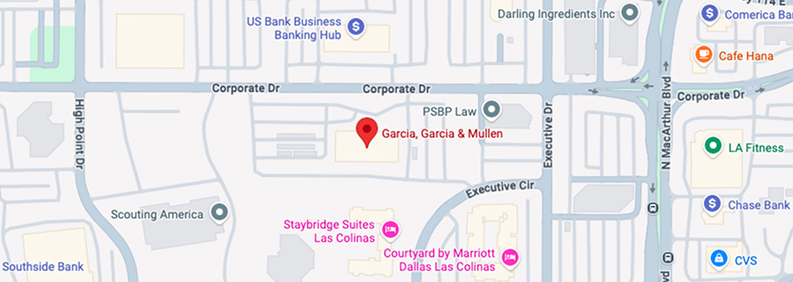 View Map/Directions




Phone: (214) 214 1000
Phone: (214) 214 1000